.edge - SDI Configuration
This topic describes how to configure the SDI I/O capability of a processing blade.
Overview
Each rear I/O plate is equipped with 48 x HD-BNC for SDI interfacing, where the number of available SDIs is determined by the active SDI licenses on the processing blade.
By default, every blade includes a single license (for 16 x SDI). If additional ".edge_sdi" licenses are available, then the total number of interfaces can be increased (to 32 or 48 x SDI). In each case, the user can choose one of three SDI I/O configurations to determine the number of SDI inputs and outputs.
All of the possible configurations are described in .edge - Rear I/O Plates. The rest of this topic deals with the configuration of the blade (from HOME).

It is important to consider the operating mode of each blade before ordering your licenses (as not all licensed options are supported by all FPGA modes).
Licensing Information
Each .edge_gateway processing blade includes a single .edge_sdi_inc license (for 16 x SDI). The .edge_SDI license can be used to expand the number of active SDIs (for 32 or 48 x SDI).
Licensing Requirements:
- 1 x .edge_sdi_inc license is included (per blade). This is a perpetual license.
- Up to 2 x .edge_sdi licenses can be added (per blade). This can be achieved using perpetual license(s) and/or credits.
SDI Configuration (from HOME)
To configure the SDIs, there are three steps:
- Setup the SDI licensing.
- Define the total number of SDIs.
- Choose one of the three SDI I/O configurations (to setup the bi-directional connectors).
All three steps can be performed from the License Configuration page (in HOME's Advanced parameters).
In addition, step 3 can be performed from the General settings. This can be useful if the licenses are already in place and you just want to change the SDI in/out configuration.
Using the License Configuration page
All of the licensed features are managed using the License Configuration page (in HOME's Advanced parameters). From here, you can choose to use perpetual licenses and/or Lawo Flex credits to unlock the additional SDIs.
Please note: To use Lawo Flex credits, the blade's system clock must be correct. This can be achieved either by synchronizing the blade to an NTP server or extracting Time of Day from PTP arriving from the network.
To use perpetual licenses:
- Please follow the steps (described earlier) to upload and fetch the perpetual licenses.
- Once the licenses are detected, the SDI Block[16] Available field updates.
- If the maximum of 2: Perpetual licenses are found, then the additional SDIs are fully licensed and you can move on (to configure the Additional SDI field).
- If there are fewer than 2: Perpetual licenses, then the remaining SDIs can be unlocked either by fetching a new perpetual license or enabling the Lawo Flex credits.
To use Lawo Flex credits:
- Enter a value into the SDI16 Subscription Licenses field. This should be equivalent to the number of perpetual licenses required.
The permitted values are dependent on the number of perpetual licenses as follows:- If there are 0: Perpetual licenses, then you can enter 0, 1 or 2 (to unlock 0, 16 or 32 additional SDIs via credits).
- If there are 1: Perpetual licenses, then you can enter 0 or 1 (to unlock 0 or 16 additional SDIs via credits).
- If there are 2: Perpetual licenses, then the additional SDIs are already fully licensed (and so a value of 0 is shown and the field cannot be edited).
- Scroll down to TAKE Configuration Changes and click on Trigger Event (to apply any changes).
- The processing blade goes offline, temporarily, to reboot and load the new configuration.
Once the required licenses are in place, you can define the total number of SDIs (using the Additional SDI parameter), and then choose the SDI I/O configuration.
There are always three SDI I/O configuration options that are dependent on the Additional SDI value as follows:
- Additional SDI = None (16 in total)
- SDI I/O Configuration (1) = 8 in + 8 out
- SDI I/O Configuration (2) = 4 in + 12 out
- SDI I/O Configuration (3) = 12 in + 4 out
- Additional SDI = +16 (32 in total)
- SDI I/O Configuration (1) = 16 in + 16 out
- SDI I/O Configuration (2) = 8 in + 24 out
- SDI I/O Configuration (3) = 24 in + 8 out
- Additional SDI = +32 (48 in total)
- SDI I/O Configuration (1) = 24 in + 24 out
- SDI I/O Configuration (2) = 16 in + 32 out
- SDI I/O Configuration (3) = 32 in + 16 out
For more information about the connectivity, please see .edge - Rear I/O Plates.
Any changes to the Additional SDI and SDI I/O configuration must be applied by scrolling down to TAKE Configuration Changes and selecting Trigger Event. The blade goes offline, once again, to reboot and load the new configuration.
After the reboot, the setup of the SDIs is complete. The new I/O configuration can be checked from the SDI I/O tab.
Using the General Settings
Once the total number of SDIs are defined (in the Advanced → License Configuration page), it is possible to change the SDI I/O configuration from the General settings tab.
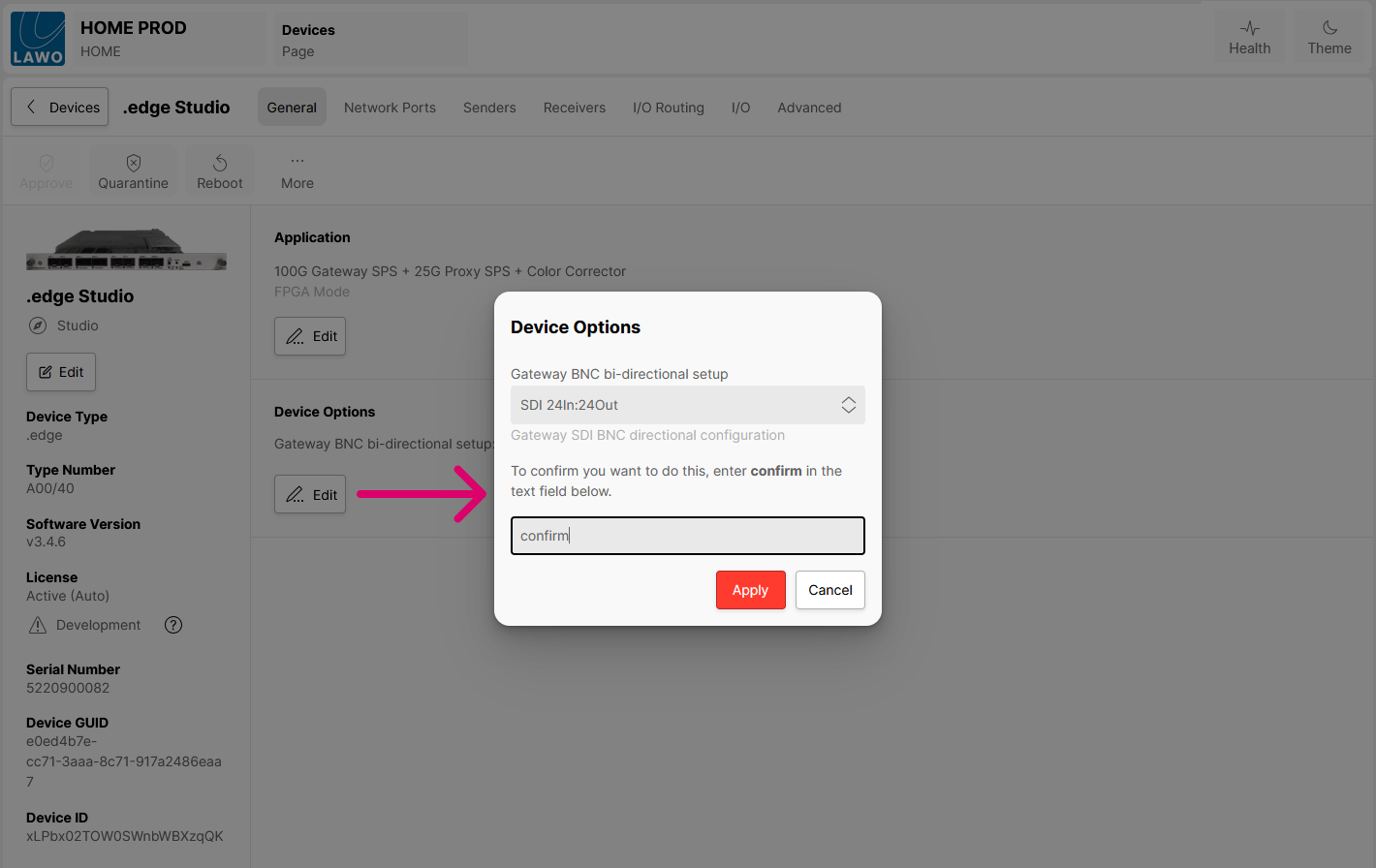
- From HOME's 'Devices' list, click on the label of a processing blade to open its 'General' settings page.
- Click on the Edit button (under ‘Device Options’).
- Choose one of the three options from the drop-down menu.
The possible options are dependent on the Additional SDI parameter (as described above). - For security, you must enter the confirmation text and then click Apply.
- The processing blade goes offline, temporarily, to reboot and load the new configuration.
- After the reboot, the new I/O configuration can be checked from the SDI I/O tab.