HOME - Device Status and Admissions
In HOME's 'Devices' list, the Status column shows the status of the network's devices:
- Physical devices can be online, offline, quarantined, unlicensed or have No HOME Pass.
- HOME Apps can be online, inactive, unlicensed or have No HOME Pass.
For a physical device, the Status and Admissions combine to indicate whether a device is fully approved (and part of the operational network) or in some other state (e.g. partially approved or in quarantine). In this instance, the Approve and Quarantine buttons can be used to manage which devices are part of the operational network. This is described in more detail here.
Please note: The admissions service can be disabled from HOME's system settings (as described here). In this instance, only the status field is relevant and the admissions show as "-" for all devices.
The example below shows a mixture of gear (Lawo and third-party) where the admissions service is enabled:
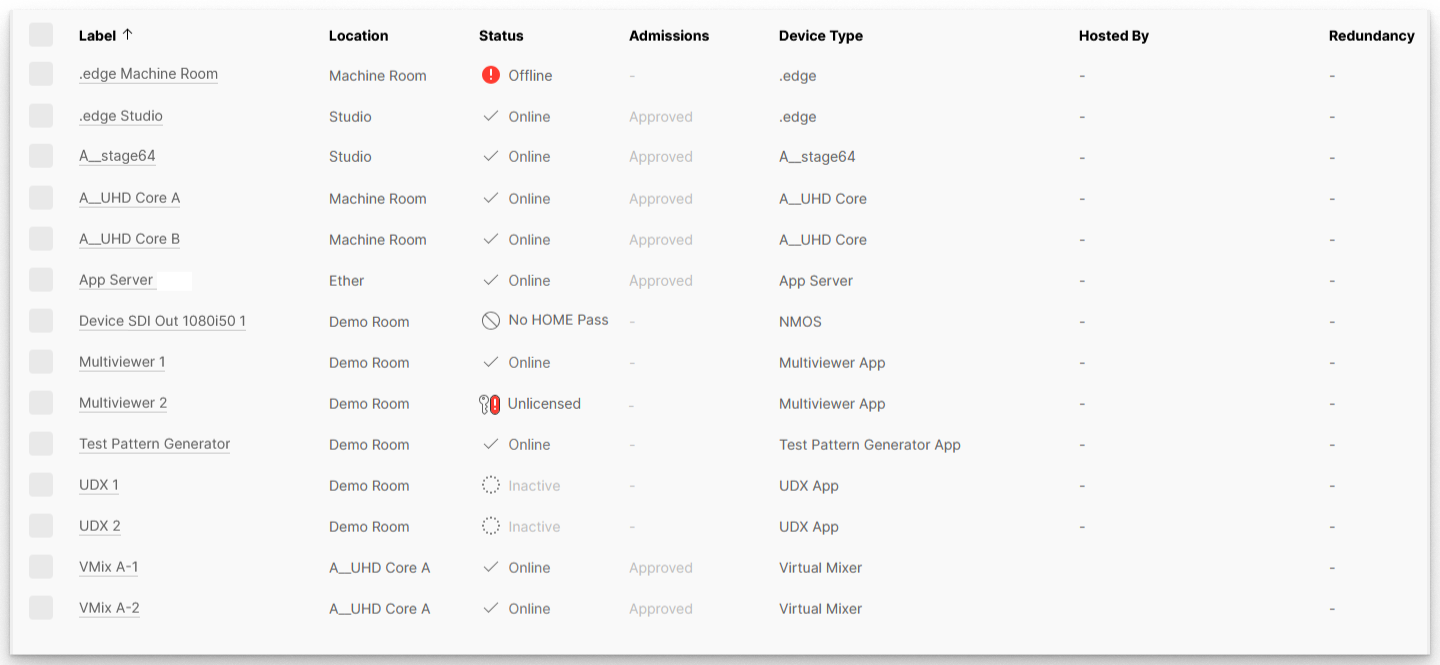
The descriptions that follow explain how to interpret the Status (and Admissions) fields for devices and apps:
Physical Devices
For a physical device, the Status and Admissions combine to indicate the following meanings. If the admissions service is disabled, then only the status field is relevant and the admissions show as "-" for all devices.
| Status | Admissions | Meaning | |
|---|---|---|---|
Online | Approved | The device is fully approved and part of the operational network. | |
Online | Partially Approved | The device is partially approved. | |
Online | Unknown VLAN | The device belongs to an unknown VLAN. | |
Offline | - | The device is either powered off or not connected to the network. | |
Quarantined | - | The device is in quarantine and awaiting approval. How to approve (or quarantine) a device is described here. | |
Rebooting | - | The device is rebooting. This is a temporary status that updates once the reboot is complete. | |
Unlicensed | - | If a device is Unlicensed, then its current usage exceeds the available perpetual licenses or credits. See Unlicensed. | |
No HOME Pass | - | If a device has No HOME Pass, then it cannot be configured or controlled by HOME. See No HOME Pass. | |
HOME Apps
For HOME Apps, the admissions service is not relevant to the individual apps, but does apply to the app servers (as described for the physical devices above).
For the individual apps, there are four possible statuses: online, inactive, unlicensed and No HOME Pass.
| Status | Meaning |
|---|---|
Online | If an app is Online, then it has been started (using Start App). Note that the Online status does not necessarily mean that the app is ready for operation (as there could be an issue with the deployment of the processing on the app server or the startup of the app). To confirm that the app is running and "healthy", click on the app label (to open the 'Device → General' settings) and check the Lifecycle area. Here you will see which server the app is using, the health status (reported from the server) and how long the app has been running. If the status shows as "Currently reporting healthy", then the app is ready to use. |
Inactive | If an app is Inactive, then it is configured but not running. An app becomes Inactive after it is stopped (using Stop App). |
Unlicensed | If an app is Unlicensed, then its current usage exceeds the available perpetual licenses or credits. See Unlicensed. |
No HOME Pass | If an app has No HOME Pass, then it cannot be configured or controlled by HOME. See No HOME Pass. |
Status = Unlicensed
If a device, app or service is Unlicensed, then its current usage exceeds the available perpetual licenses or credits. This can occur if a licensed function or app is already running and either its perpetual licenses are missing or its credits have been revoked.
Missing Perpetual Licenses
Perpetual licenses offer permanent availability and so, once a licensing file is uploaded to HOME, they are unlikely to go missing. However, this is possible if, for example, a licensing file is deleted or a new file is installed and its license contents are invalid.
Missing Credits
If the credit validity is allowed to expire, then the credits are removed (from HOME) and returned to the original subscription (in the customer's Lawo Flex account), a process known as a revoke.
In practice, there are a number of reasons why credits may be revoked:
- the credit validity has expired;
- an auto-revoke date has been set (and reached);
- the user has performed a manual revoke (to assign the credits elsewhere);
- the underlying subscription has expired.
What happens to unlicensed devices and apps?
If the current usage exceeds the available perpetual licenses and credits, then there is no immediate change to the operation of the device or app. Any functions that are enabled, or apps that are started, will continue to run in their current state. This allows productions to be completed. The change in usage only becomes relevant once a device or app is stopped, or the entire system / app server is shutdown. In this instance, the device or app cannot be started again until the licensing issue is resolved.
To alert the user that some action needs to be taken, the affected devices and apps are marked as Unlicensed in HOME's 'Devices' list. In addition, if the licensing issue is due to missing credits, then two red warnings are displayed: Exceeding Credits (beside the Health icon) and a Critical Error banner (at the bottom of the page). An example of what this looks like can be found here.
Fixing Unlicensed Devices and Apps
Then check the licensing configuration for the individual device(s) or app(s).
If there are not enough available perpetual licenses or credits, then there are four possible courses of action:
- Add more perpetual licenses (of the correct type) by uploading a new licensing file.
- Assign more credits to the HOME system (using the my.lawo.com licensing portal). To do this, you may need to activate a new Lawo Flex subscription or revoke some credits from another HOME system. Please see:
- Release some credits (e.g. by stopping some apps).
- Reduce the licensing requirement (e.g. by editing the configuration of the device or app).
Status = No HOME Pass
The No HOME Pass status can occur if a HOME Pass has been removed by a user, or if new devices have been added to the network and their HOME Pass (perpetual licenses) have not been uploaded to the HOME system.
You can find more information about HOME Pass licenses here. For now, it is useful to know that:
A valid HOME Pass is required for each device, app or service that you wish to configure and control from HOME.
This can be achieved using either a perpetual "HOME Pass" license or an equivalent amount of credits.
- From HOME v4.0 onwards, all new Lawo gear (including HOME Apps) ships with a perpetual HOME Pass license (included).
- HOME Passes for any NMOS-compatible or third-party devices must be ordered separately. In this instance, 1x HOME Pass is required for each operational device.
- HOME Passes are generic and can be used for any device, app or service.
- The assignment of HOME Passes is controlled from the ...More drop-down menu in HOME's 'Devices' list. This allows users to manually reassign HOME Passes (as described here).