The Advanced → Senders menu provides information and configuration controls for the app's media network senders.
There is a main page with global parameters, plus a sub-page for each available sender.
For a HOME Timecode Generator, there are up to 8 output senders:
- TX 1 = Timecode Generator Output 1
- TX 2 = Timecode Generator Output 2
- ...
- TX 8 = Timecode Generator Output 8
The senders can be viewed and configured separately.
Please note: The number of senders are dependent on the Number of Output Streams and Output Meta Transport options defined in the app configuration.
This topic describes the Advanced menu controls on the main and TX n sub-pages.
Senders
The main 'Senders' menu contains a single control that applies to all configured senders.
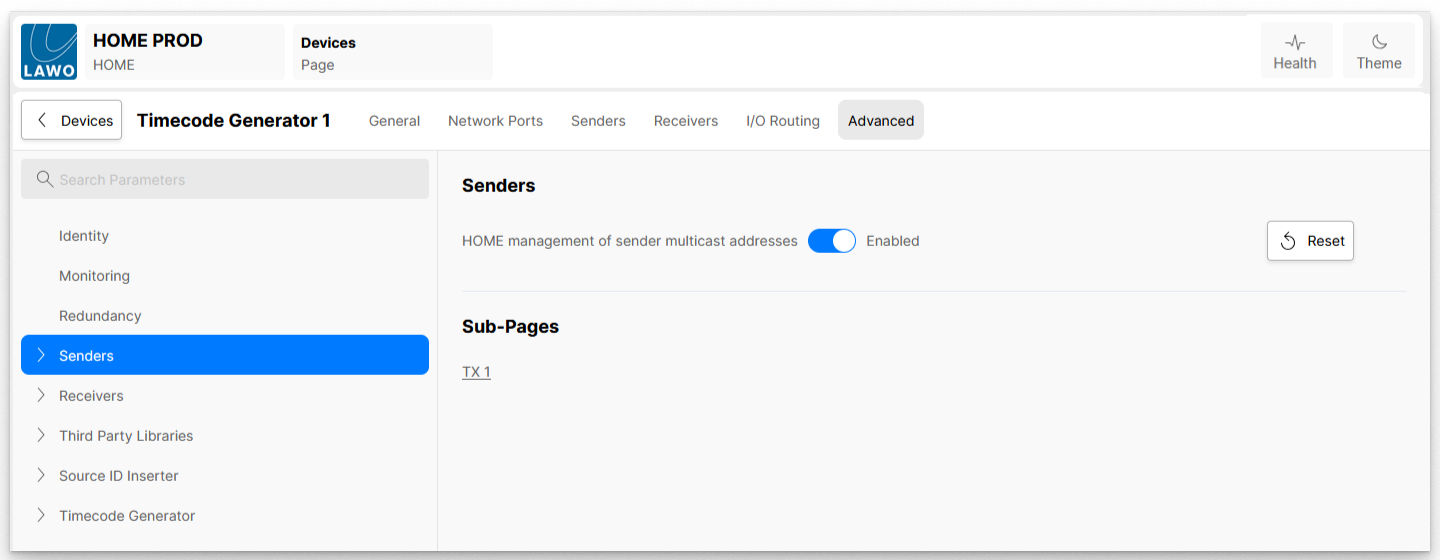
| HOME management of sender multicast addresses | This option defines how the multicast addresses (for the senders) are assigned, when they are first created: - When enabled, multicast addresses are assigned to the individual essence flows by HOME's 'Oratio' service.
- When disabled, multicast addresses are automatically generated based on the IP Address of the App Server that is currently running the app.
Please note: The multicast address can be overridden from the 'Edit Sender' dialog. See HOME Apps - Edit Sender or Receiver. |
Senders → TX n
The 'TX n' sub-menus can be used to view and adjust settings for an individual sender:
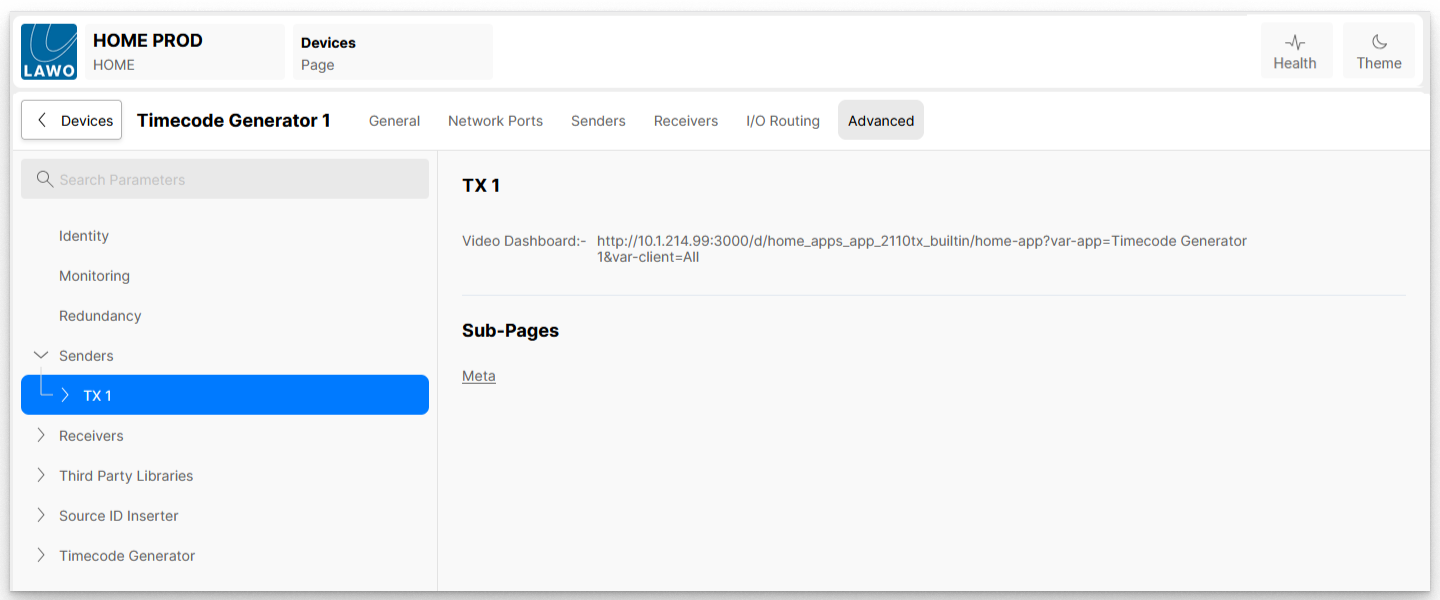
The page contains a link to a predefined Grafana Dashboard that can be used for monitoring purposes, plus a single sub-page: Meta.
SDP Information
Selecting the Meta sub-page reveals the SDP file associated with the metadata sender. The user is not able to modify the SDP, but can copy the SDP information. This can then be pasted into the SDP Data of a receiver as an alternative method of routing signals (known as SDP Patching).
The SDP file information is also available to automation systems, such as VSM, via the HOME API.
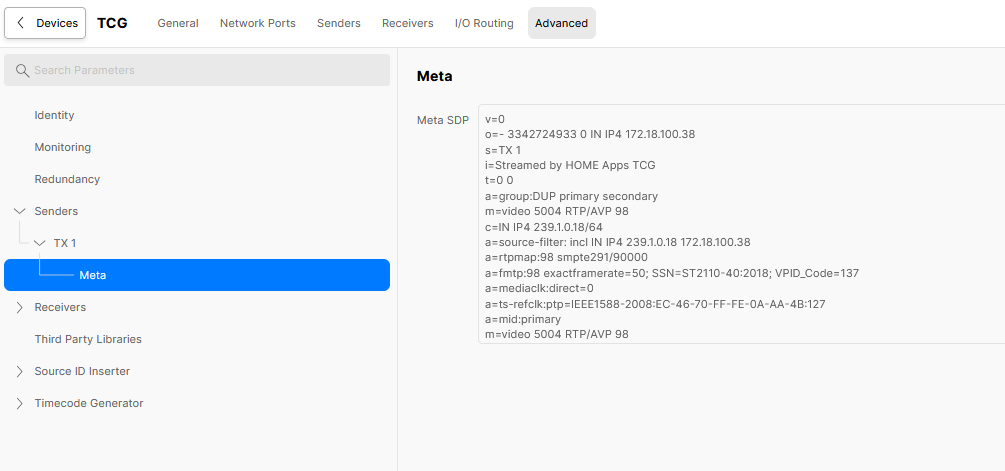 Note that the same SDP data can be accessed from the app's 'Senders' page (as described in HOME Apps - SDP Data).