Use Case 3 – Temporary Production Setups and Event-Based Signal Exchange
Scenario Overview
This use case focuses on temporary and highly dynamic production environments, such as:
- Large-scale sports events
- Cultural or entertainment productions
- Special live event coverage
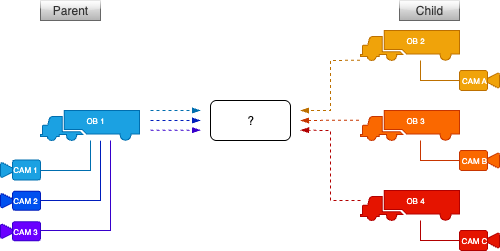
Large scale types of these scenarios typically involve multiple independent production units, such as outside broadcast (OB) trucks or mobile production facilities, which are brought together for a limited period of time.
To enable collaboration, these otherwise autonomous systems are interconnected via a temporary IP network, creating the need for flexible, ad-hoc signal exchange between production units.
Operational Challenge
Traditional approaches to interconnecting such systems often come with limitations:
Predefined signal mappings
- Exchanges must be configured in advance
- Changes require effort on both participating systems
Proprietary interoperability mechanisms
- Often tied to specific vendors
- Require homogeneous system environments (e.g., vendor-specific tieline management)
These constraints reduce operational flexibility and increase setup complexity—especially in dynamic, time-critical environments.
Implementation Using Stream Share App
The Stream Share App (SSA) enables a significantly more flexible and efficient approach by leveraging NMOS-based interoperability.
Simplified Setup
- The preparatory effort is focused on the originating (managing) system
- The receiving system only needs:
- An NMOS Registry
- Basic network connectivity (IP reachability)
No complex bilateral configuration is required.
Dynamic Signal Exchange
Once connected and running:
- Signals are exchanged via simple routing operations into and out of involved systems, using the SSA
- This applies to both directions:
- From the controlling system to consuming systems
- From remote units back to the origin
During live operation:
- New signals can be added dynamically
- Existing paths can be disconnected at any time
This provides true operational agility in rapidly changing production environments.
Flexible Network Topologies
The SSA approach is highly adaptable and does not impose structural limitations on the production network.
Possible topologies include:
Centralized models
- One master system distributing signals to multiple clients
Mesh-based exchange
- Multiple production units sharing signals with each other in a decentralized manner
The choice of topology can be adapted on demand, depending on the production requirements.
Scalability
The solution scales seamlessly:
- Independent of the number of connected production units
- Independent of the volume of exchanged signals
SSA instances can be deployed and adjusted as needed without structural limitations.
Operational Lifecycle
Temporary production environments benefit from the SSA’s lightweight lifecycle management:
- Stream Share Apps can be started and stopped at any time
- NMOS export connections can be enabled or disabled dynamically
- Associated licenses or credits are released immediately after use
This allows for:
- Efficient resource utilization
- True on-demand operation
- Minimal overhead outside active production phases
Key Benefits
- High flexibility for ad-hoc and live production scenarios
- Minimal setup effort, especially on the receiving side
- Vendor-independent interoperability via NMOS
- Dynamic, real-time control of signal exchange
- Support for various network topologies (centralized or mesh)
- Efficient use of temporary resources and licensing
Involved Lawo Products
- Lawo HOME with NMOS Exporter
- Lawo HOME Apps
Required other Products
- NMOS Registry (1 per remote site, e.g. Lawo HOME)
Required setup
- Network links (eg. 100G, 200G, 400G) between involved systems.
- Friendly address ranges (reachable, no duplicates)
More useful Information