When preparing a network for HOME Apps, it is useful to understand how the processing (on the app server) is controlled and managed by HOME.
The system architecture is based on a library of containers that run on the app server. Each container is dedicated to a specific processing task (e.g. 2110 Receiver, 2110 Sender, NDI Receiver, etc).
When the user starts an app, HOME dynamically selects and combines the required containers. The container bundle (for the app) uses a certain part, or slice, of the app server.
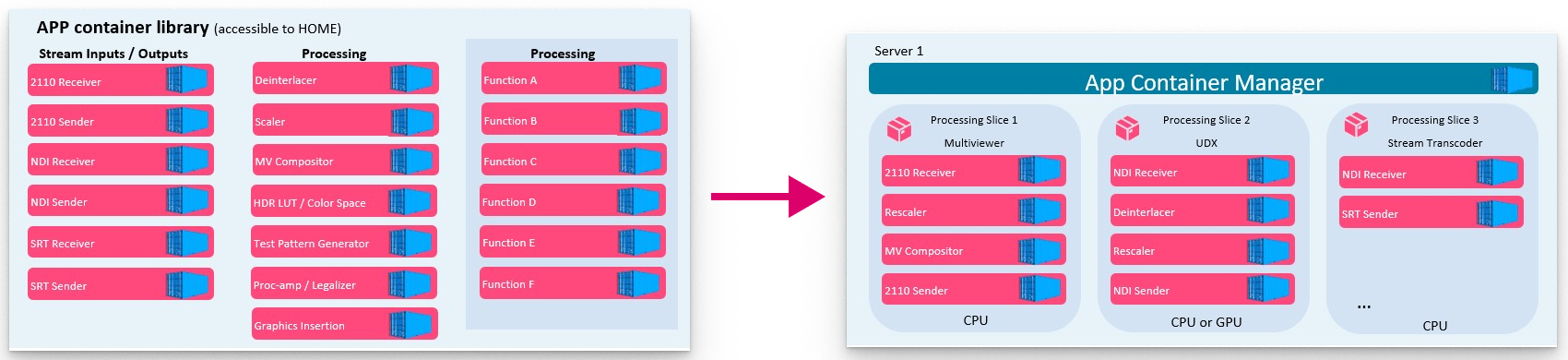
This approach has several advantages:
- Apps can be started and stopped on demand. If an app is not required for this week's production, then the server capacity (and licenses) can be reused. If an app server becomes unavailable, then a different server can be used.
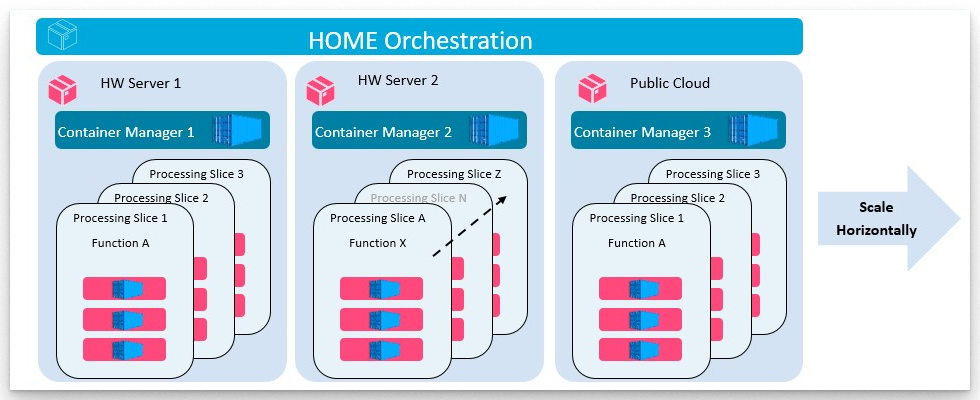
- The system is easy to scale, by adding (or removing) server capacity. This can come from CPU and/or GPU running on a hardware server or, in the future, the public cloud.
- Power consumption can be optimized. When an app is not running, the server does not consume the power normally needed to run an app. The user could even shutdown the server if it is not needed for a longer timespan.
- Lawo's product development is more efficient, as apps can reuse existing containers and inherit new features across all apps.
- Customers can benefit from the fast-evolving development of "off the shelf" IT servers and the economies of scale.
The image below shows how HOME orchestrates the processing on the app server(s).
The image below shows some typical requirements for a small, medium and large HOME Apps server.
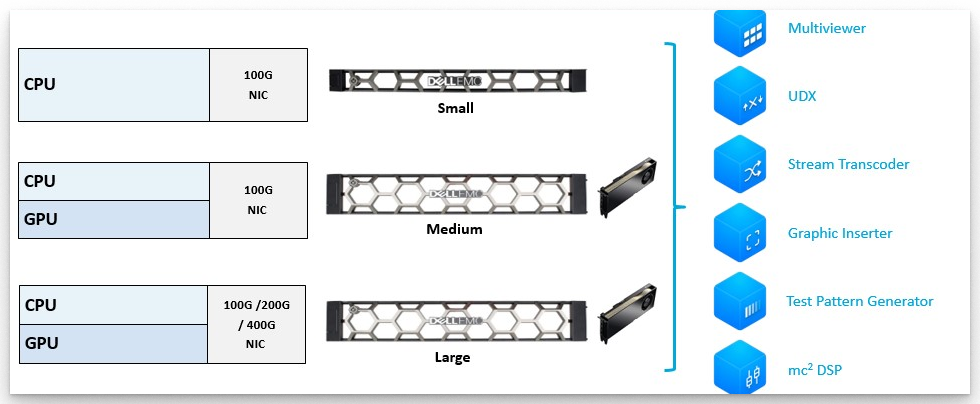
Lawo has certified a number of servers for use with HOME Apps. These range from small to large depending on the customer requirements. For more information about the Lawo-certified server packages, please contact your local Lawo sales representative.