mc²56 - Aliases
Aliases are a type of virtual loopback signal with common Type and ID attributes. They can be used, in the Signal List display, to standardize a signal's address (so that it can interpreted in the same way across all mc2 systems).
Aliases have two main applications: production portability between different mc2 consoles and integration with the Waves plug-in system.
How do Aliases work?
There are two types of aliases: Tielines and Waves.
Each alias has a common identifier (ID). By patching I/O signals via aliases, instead of directly, you can create a production where the signal routing can be loaded, in the same way, by any mc2 console.
All alias signals can be found in the Aliases directory in the Signal List. There are four sub-directories on both the source and destination sides. The Waves aliases are for use with the Waves plug-in server option. The Tieline aliases are for everything else.
Sources:
- Tieline Receiver Outputs
- Tieline Sender Outputs
- Waves Return Outputs
- Waves Send Outputs
Destinations:
- Tieline Receiver Outputs
- Tieline Sender Outputs
- Waves Return Outputs
- Waves Send Outputs
Production Portability
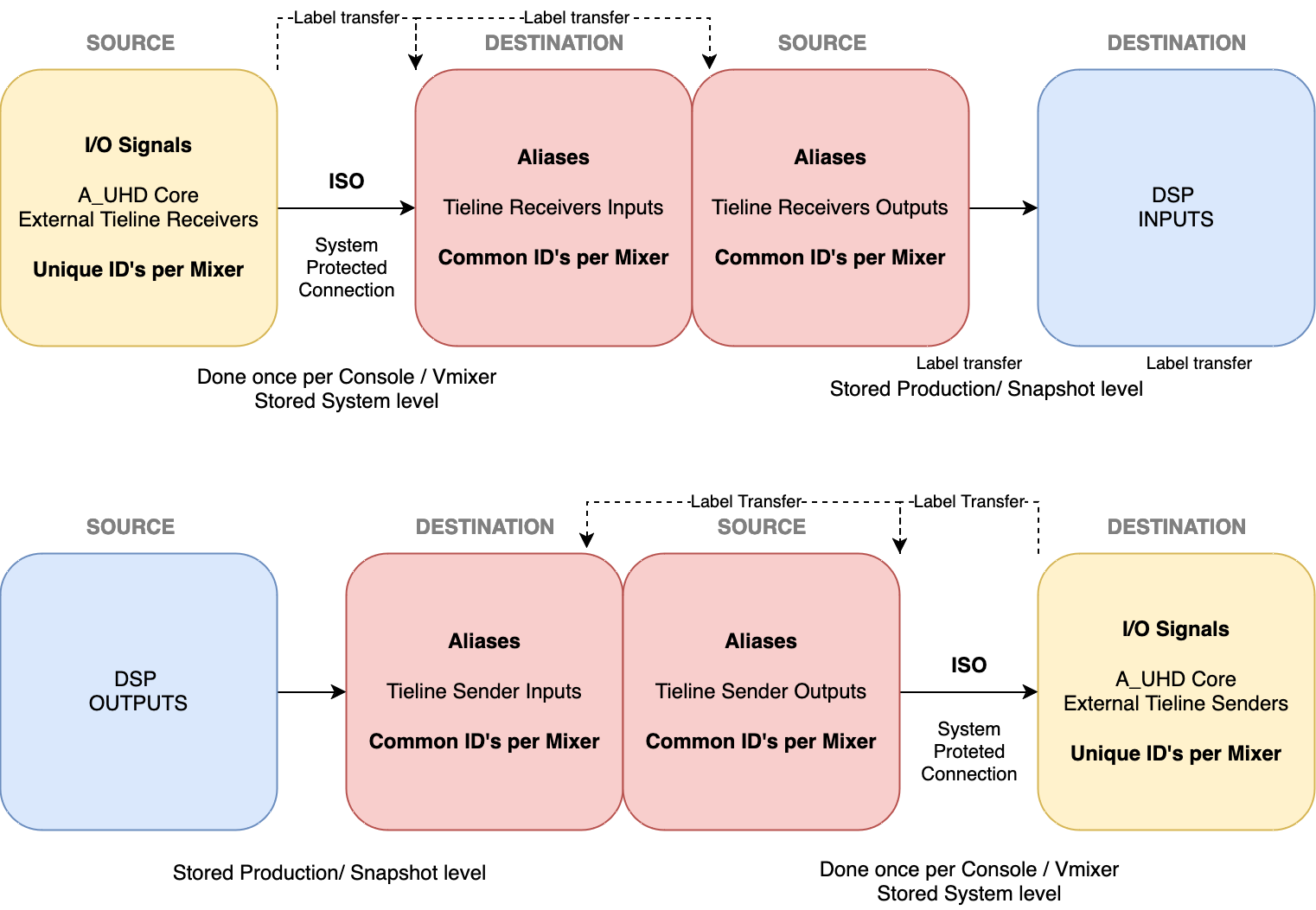
In a system where the A_UHD Core's External Tielines with Stream Replication is employed across different virtual mixers (vmixers), the same audio signal appears with different IDs on different vmixers. This happens because each vmixer assigns its own unique identifier to the replicated signal, even though the actual audio content is the same.
By patching the External Tieline resources via the Tieline aliases, you can ensure that this signal will now utilise the same ID across all consoles. When you manually patch the signal through the Tieline Receiver and Sender (which you only need to do once), this standardizes the signal's address.
As a result, production can be shared seamlessly between different control systems, and all consoles will recognize the signal with the same ID, maintaining consistency across the setup.
The following diagrams illustrate how this works. Aliases ensure consistent signal IDs across different control systems, after the External Tielines of the A_UHD Core are mapped.
Waves Integration
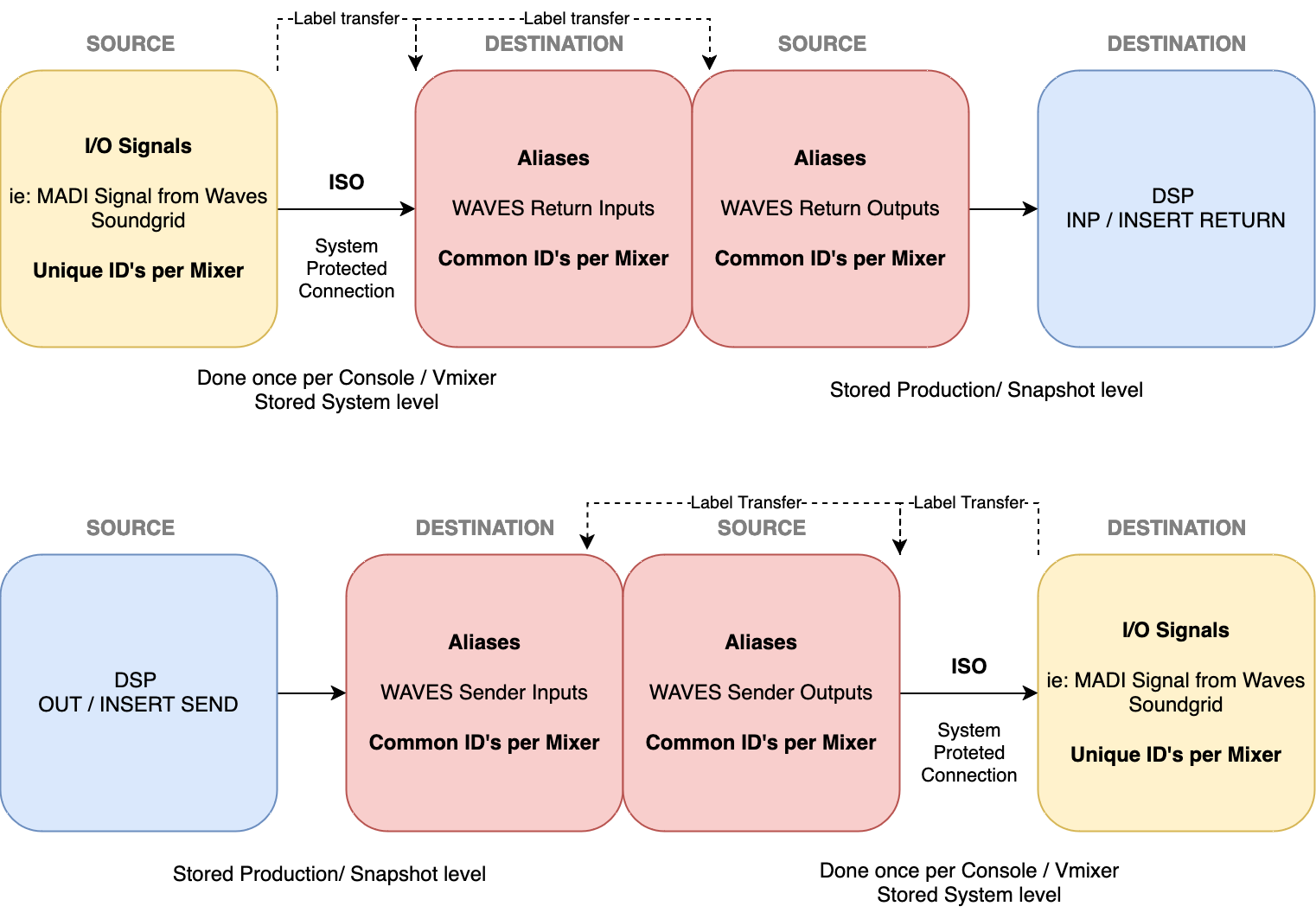
For Waves signals, the logic is the same.
In the example, illustrated below, the MADI inputs and outputs to and from the Waves system are linked using the Waves aliases. The Waves Alias ID signal type is then used to communicate with the Waves Soundgrid Server.
Alias Properties
Other properties of this new type of loopback:
Label Inheritance
When connecting an Alias input loopback destination signal to a source signal, the source signal's label is automatically copied to both sides of the loopback. Similarly, when an Alias output source signal is connected to a destination, the destination signal’s label is copied to the loopback. Alias signals inherit source labels and destinations from external tielines, making it easier for the users to identify the source channels.
If the connection is removed, the label reverts to the default loopback label, unless the user has set their own. To reset to the default, disable "Label User Modified" and "Short Label User Modified" in the Signal Parameters dialog.
Source Parameter Propagation
When an external signal, such as a Mic, is connected to an input via an Alias, its source options (i.e. gain, Filter, etc) are made available as if the signal were connected directly.